|
The first and only player to conform to the MCA DiscoVision specifications is also arguably one of the best players to view DiscoVision discs on. The player is an industrial player, put to use in nearly every General Motors dealership in 1979-80 to show off the 1980 line of autos as well as a source of training films on everything from carburetor repair to customer service. This model (under the nameplate Pioneer Model 3) was tucked neatly underneath thousands of  arcade video games. Those with a talent for digging could also find them in arcade video games. Those with a talent for digging could also find them in  arcade conversions. Just goes to show you the player can really take the punishment of constant use. arcade conversions. Just goes to show you the player can really take the punishment of constant use.
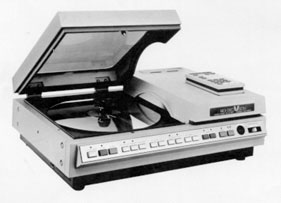 Pressing Play spins the disc in the opposite direction from conventional LaserDisc players as the pickup is mounted above the disc. The disc then slides underneath the pickup and begins playback. Equipped with a massive 1kb of memory, the player could execute programs stored as data dumps encoded on the Analog Right channel. Basic player controls are available on the front panel. A full-featured programming remote can be used either by IR or wired connectivity. The player is also equipped with a bi-directional parallel data link via 24-pin Centronics connector. RS-232 connectivity was possible with the addition of a UEI-232 interface box, which provided a DB-25 standard serial port.
Pioneer engineers really created something special with this player. The Level II data dump functionality allows for menu functionality, selecting options from a still frame (I suppose motion would be possible as well), executing the selection and then returning to the menu. This level of User Interactivity without an external computer would become standard with the introduction of DVD, 18 years later.
The player incorporates a fully solid-state tangential system to compensate for time based correction errors, rather than utilizing a moving mirror. Pioneer would use the tangential mirror system up through the CLD-900 in 1985.. The system yields an excellent picture on CAV discs, in part because of the extremely short wavelength of the HeNe laser, at 632nm. CLV playback is generally problematic, with excessive crosstalk, even on a perfectly calibrated player.
On startup, the player will move to the "anticipated inner limit" and obtain sync. On CAV discs it will then search to frame 0, beginning playback while squelch the audio and video until frame 1 is reached. This effetely eliminates all opening bumpers on most DiscoVision discs. The interesting side-effect is on mode feature films on side 1, frame 0 lands midway in the DiscoVision opening, but will not advance to 1 until after the "Universal" logo plays. On CLV discs, once sync is obtained, the player "scans" to the inside limit and begins playback.
The PR-7820 is the only LaserDisc player to NOT incorporate the Philips specification. That specification allowed for encoding of frame numbers, chapter number and enhanced player functions inserted into the vertical blanking interval at specific locations. For example the MCA code calls for frame numbers and elapsed time to be stored on line 10. In the Philips specification, frame numbers are stored on lines 17 and 18. The MCA code includes a "Pilot" signal be present on the disc which the player uses for various operations. The Philips code does not include this "Pilot" signal. In the absence of the MCA code, the player has no idea what kind of disc is loaded. Frame/time display is not available and searching is not possible. Surprisingly the discs do play - even CLV discs. But without the frame numbers playback starts at the "anticipated" lead-in. For backwards compatibility, Pioneer and all LaserDisc manufacturers included the MCA code on all discs up through the early 90s. For industrial pressing runs, Pioneer and 3M would restore the MCA code functionality if requested to do so.
As a result of the missing Philips code, Frenzy Side 5 plays great!
|

